
Sweating the Bar and Raising the Details
Management meetings were built for an older information system. Poor writing keeps the machinery alive, and one calendar invitation can commit thousands before anybody acts.
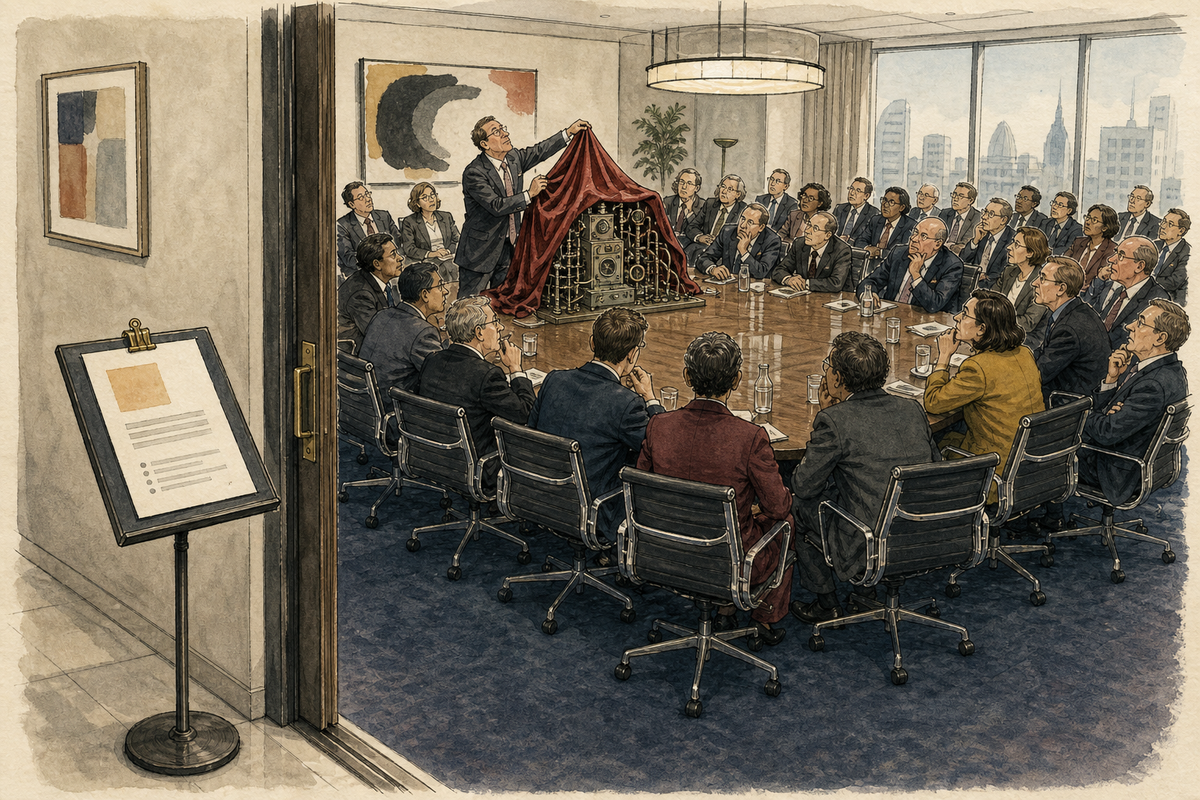
Andy Grove designed meetings for an older information system. We kept the meetings after replacing the system.
“We need to sweat the details on raising the bar,” somebody said in a meeting.
The explanation that followed was sensible. The sentence was not. It contained two exhausted metaphors, no detail and no bar. Rearranged as “we need to sweat the bar and raise the details,” it lost surprisingly little.
This is a useful test of corporate language. If its phrases can be rearranged without changing what the listener knows or does, the sentence carried mood, not information.
The mood is familiar. We are serious. We have standards. Further purposeful activity will occur. What remains unclear is which standard, what must change, who will change it and how anybody will know when the bar has completed its ascent.
Poor corporate English does more than offend the ear. It transfers the work of interpretation to everybody downstream.
This is not another complaint that a meeting could have been an email. Much of modern management was built when information was difficult to distribute and preserve. That cost has collapsed, but the organisation built around it remains. When leaders do not write clearly, meetings and managers become the missing transport and interpretation layer.
English as a Coordination Problem
A vague managerial instruction creates a small queue downstream.
Someone asks what “raising the bar” means. A meeting aligns on the ambition, a presentation socialises it and managers cascade it. A working group eventually defines the details. Weeks later, the organisation has produced abundant communication from a sentence containing no decision.
Clear writing removes much of this machinery.
“We need to improve quality” sounds unobjectionable because it makes no choice. “From October, releases with unresolved critical accessibility failures will not ship” is useful because people can dispute it. They can challenge the threshold, the date, the owner or the cost. The sentence exposes the decision while there is still time to change it.
Precise writing need not command agreement. It must make disagreement possible before the organisation acts.
Corporate euphemism avoids the discomfort. Owners become passive verbs, decisions become aspirations and problems become opportunities. Aggression performs the same trick by making tone the subject.
Professional writing needs neither.
“There may be an opportunity to strengthen accountability” conceals the problem. “You have failed to take ownership” makes the person the problem. “Security owns this control; the current implementation does not meet the agreed requirement” identifies the gap and leaves motives alone.
Plain English does not avoid difficult meaning. It delivers it without fog or humiliation.
This is not a test of literary polish or native English. An imperfect sentence with a clear owner, action and reason is more useful than immaculate corporate jargon.
That burden of interpretation helps explain why meetings became so central to management in the first place.
The Meeting Was Also a Distribution System
In *High Output Management*, published in 1983, Andy Grove treated meetings as part of the production system of management. Regular one-to-ones, staff meetings and operational reviews exchanged information, surfaced problems and supported teaching. Mission-oriented meetings addressed a specific problem and usually produced a decision.
Grove demanded preparation, a defined purpose and only the people required. He also wrote for an organisation in which information was harder to distribute, preserve and recover. Meetings carried context as well as interpreting it. They were part of the communications infrastructure.
We now have searchable internal channels, shared documents, versioned repositories, operational data and recorded decisions. One person can publish an authoritative explanation to several thousand colleagues at negligible distribution cost. Others can challenge it without sharing a calendar, and somebody joining six months later can recover the reasoning.
I have argued that managers should not be used as distribution lists. The same distinction applies here. Information no longer needs a room merely to travel, but some problems still need people to interact.
When reasoning is published once, people can recover the context themselves. Managers relay fewer messages, specialists repeat fewer explanations and decisions need not be reconstructed from memory. This is organisational design, not etiquette.
We retained the recurring meeting even after much of its information-distribution work had disappeared.
When the Purpose Is Information, Write It
Writing and meetings do different work. Use each for the part it does best.
I was recently invited, with more than twenty other people, to a demonstration of an internal AI tool. The invitation included no product page, documentation or link. The tool was ready to demonstrate; it was surely ready to explain.
The meeting had a budget, although nobody had written it down. With more than twenty senior people invited, it had committed several thousand pounds before anybody acted on what they learned. That excludes preparation and the cost of abandoning whatever everyone had been doing beforehand.
Preparing the audience was the cheapest part of the meeting, and the only part omitted.
Share it beforehand. Let people understand the problem, inspect the claims and arrive with useful questions. A software vendor would consider this elementary.
Writing would not replace the demonstration. It would allow the demonstration to begin at the useful part.
The same preparation improves decision meetings. A disciplined paper states the problem, evidence, options, recommendation and consequences. Others can examine the reasoning before the meeting begins. Often writing reveals that the parties were answering different questions. Sometimes the decision becomes obvious and the meeting disappears with it.
Meet when people need to explore uncertainty, resolve disagreement, teach, build trust, handle a sensitive subject or respond to an incident. These are interactions, not distribution tasks.
Four Rules for Management Writing
Choosing writing as the medium solves nothing if the document merely preserves the fog. Clear management writing is not merely a matter of style. Its job is to make ownership, decisions and consequences visible. Four of Strunk’s rules are particularly useful:
- Use active voice. Name the person or function responsible.
- Use definite, specific, concrete language. Make the proposed change inspectable and disagreement possible.
- Omit needless words. Reduce the space in which ambiguity can hide.
- Put statements in positive form. Say what will happen.
“We need to drive greater alignment around engineering excellence” has no owner, action or test.
“Engineering Directors will publish the three required release checks by Friday” may be a terrible decision. At least it is a decision.
These rules do not require every executive to sound like an instruction manual. Difficult subjects need qualification; unresolved problems deserve honest uncertainty. The meaning must still survive the sentence.
The First Draft Is Now Cheap
These rules require effort. That is part of their value. The author must organise the thought before asking others to spend time on it.
A meeting often feels easier. Ten people can be gathered before the organiser has worked out what needs deciding. This saves the organiser time by taking it from the other nine.
AI changes that bargain. It can turn notes into an argument and expose the holes.
It can also inflate six vague words into two pages of confident nonsense. Fluency proves only that somebody has access to a model.
I increasingly regard a leader’s repeated refusal to put consequential reasoning into durable form as organisational laziness. The work of ordering the thought passes to everybody forced to reconstruct it through meetings, questions and repetition.
Use AI to get past the blank page if it helps, and mark exploratory drafts honestly. Before presenting a document as authoritative, edit without mercy: remove claims you cannot defend, words that add no meaning and conclusions that do not follow.
Ask What Changes
Before sending a memo, email or presentation, ask what should change after somebody reads it.
Before arranging a meeting, ask what live interaction will add that writing cannot.
Before requesting status, ask which decision the information will change.
Before asking managers to cascade a message, ask why the owner cannot publish it directly.
Grove treated management as a production process. Keep his discipline; reconsider the machinery. Publish information, expose reasoning to challenge and meet when interaction adds something writing cannot. Record any decision or durable learning where others can find it.
And if the instruction is still to sweat the details on raising the bar, start by naming the details and locating the bar.